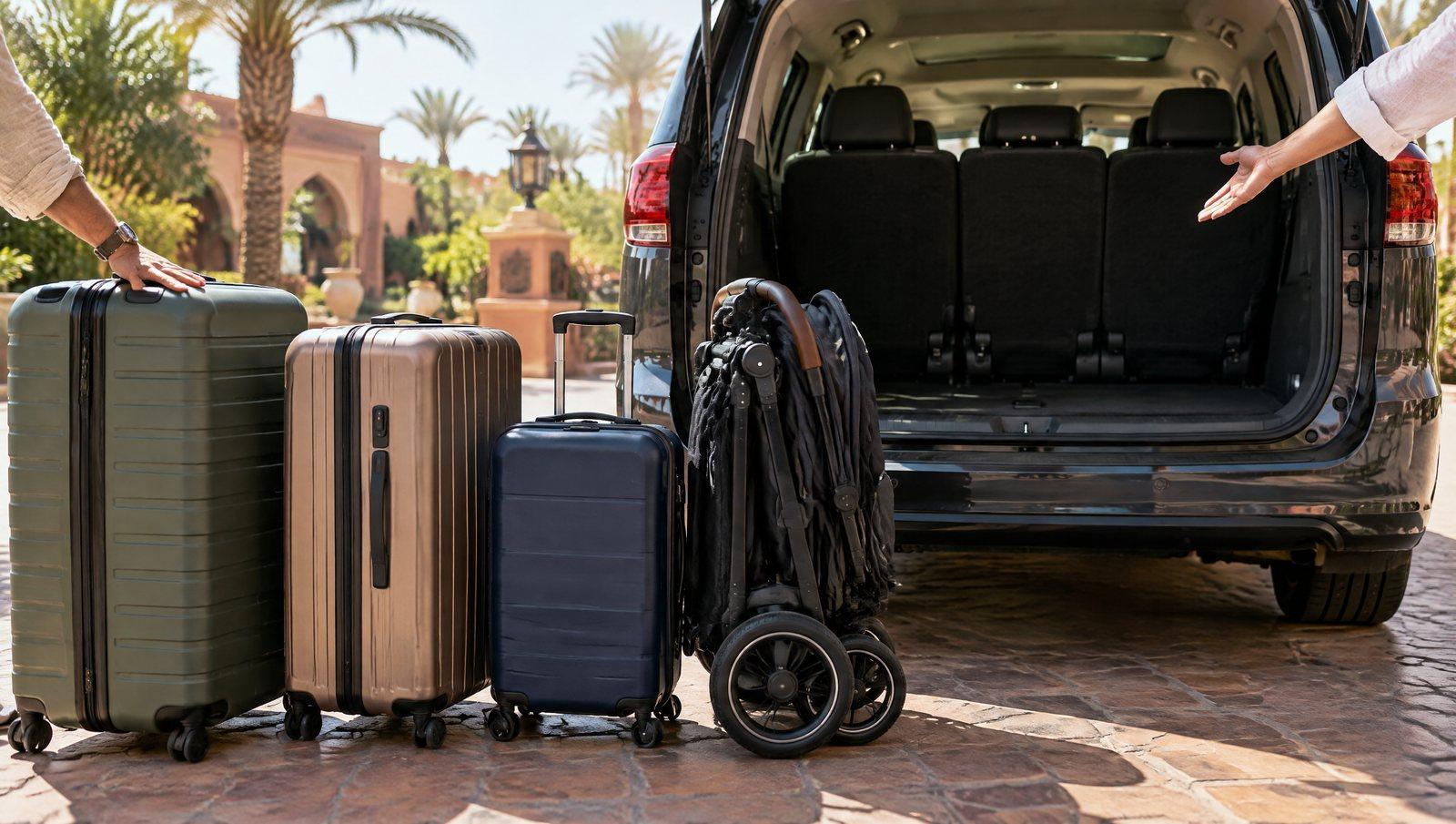
Why the number of seats is not enough
A vehicle’s seat count tells you how many people can sit with a seat belt. It says nothing about the boot. Yet luggage volume is often what decides: large suitcases, strollers, golf bags or sports equipment take up space that seats do not free. In some vehicles, using every seat sharply reduces the loading space.
Vehicle categories
The categories below are the ones used for tourist transfers. Their exact capacities vary by model: check them with the transport company, never from an average.
| Category | Typical situations | What to confirm |
|---|---|---|
| Sedan | Solo traveler or small group travelling light | Boot space for the declared bags |
| Business sedan | Travelers expecting a higher level of comfort | Planned model and luggage space |
| SUV | Small group with more luggage, rear-seat comfort | Space available when every seat is taken |
| Van | Families, small groups, bulky luggage, strollers | Seats actually usable with the luggage |
| Minibus | Larger groups | Luggage space or hold, access for people with reduced mobility |
| Coach | Large groups, seminars, events | Hold, access to the pickup and drop-off points |
Luggage that changes the choice
- Large suitcases: count them separately from cabin bags.
- Strollers, travel cots: they take the space of a suitcase, sometimes more.
- Golf bags, boards, bikes: name them; they do not fit in every boot.
- Wheelchair or medical equipment: say whether it folds and whether the traveler needs to transfer.
- Bulky purchases on the way back: think of the departure, not just the arrival.
To picture what a “large suitcase” is: IATA notes that international guidelines recommend, notably for occupational health and safety reasons, that an individual checked bag should not exceed 23 kg; on some routes using the piece concept, a common maximum dimension is 158 cm (length + width + height). Allowances remain specific to each airline and route, and these airline benchmarks say nothing about a vehicle’s capacity: only the transport company can confirm it.
Families and children
With children, give each child’s age and height in the request and ask the transport company to confirm in writing the type of child seat planned. A child seat takes a place and may change the vehicle layout. In Morocco, the regulations prohibit seating a child under ten in the front seats of a private car (Decree No. 2-10-420, article 8). For a tourist transport vehicle, ask the transport company to confirm the applicable rules and the seat planned for each child.
Groups
For a group, the question is not only “how many vehicles?” but also “should they arrive together?”. One larger vehicle keeps the group together; several smaller ones give flexibility if travelers do not arrive at the same time. Either way, set a single meeting point and a contact person.
Trip length and comfort
On a short transfer, a well-filled vehicle is acceptable. On a long journey, legroom, air conditioning and the option of a break matter more: it is often better to go one category up than to use a vehicle at its maximum capacity. Outside built-up areas, seat belts are compulsory in the front and in the back (Decree No. 2-10-420, article 7): it is therefore worth checking that every seat planned has a seat belt.
Questions to ask the transport company
- Which vehicle model is planned, and in which category?
- How many seats remain usable with the declared luggage?
- Will the bulky items reported (golf, stroller, wheelchair) fit?
- Is the requested child seat available, and of what type?
- What happens if the number of travelers or bags changes?
Common mistakes
- Requesting a vehicle from the number of travelers alone.
- Forgetting the stroller or golf bags in the request.
- Assuming a category always has the same capacity.
- Not reporting a last-minute change in the group.
- Choosing the tightest vehicle for a long journey.
Checklist before confirming
- Number of travelers, including children and their age.
- Number and type of bags, bulky items named.
- Particular needs: child seat, reduced mobility.
- Route and approximate duration shared.
- Category and model confirmed by the transport company.
Examples
- A couple with two large suitcases: a sedan is often enough; have the boot confirmed.
- A family with two children, a stroller and four suitcases: a van is usually better suited than a fully loaded SUV.
- Four golfers with their bags: report the bags; depending on the model, a van or an extra vehicle may be needed.
With WAYLISS
In WAYLISS, the property’s request states the number of travelers and bags, the vehicle category required and needs such as a child seat or accessibility. The transport company then assigns a vehicle from its fleet; once the ride is assigned, the property and the traveler see the vehicle and its plate. See guest transfer management for hotels and the complete method to better organise your guests’ transfers.
Frequently asked questions
How many suitcases fit in a sedan?
It depends on the model. State the number and size of suitcases in the request and have the transport company confirm the space.
Does an SUV carry more luggage than a sedan?
Often, but not always, especially when every seat is taken. The actual model is what counts.
Does a family need a van?
Not necessarily: it depends on the number of children, the seats needed and the luggage. A van is often the most comfortable choice with a stroller and several suitcases.
What if the number of bags changes?
Tell the transport company as soon as possible: it must check that the planned vehicle is still suitable.
Sources
- Decree No. 2-10-420 of 29 September 2010 implementing Law No. 52-05 on the Highway Code (articles 7 and 8, Arabic text) — Ministry of Justice — Adala portal (published 29 September 2010, accessed 22 October 2026)
- Passenger baggage rules — IATA (accessed 22 October 2026)