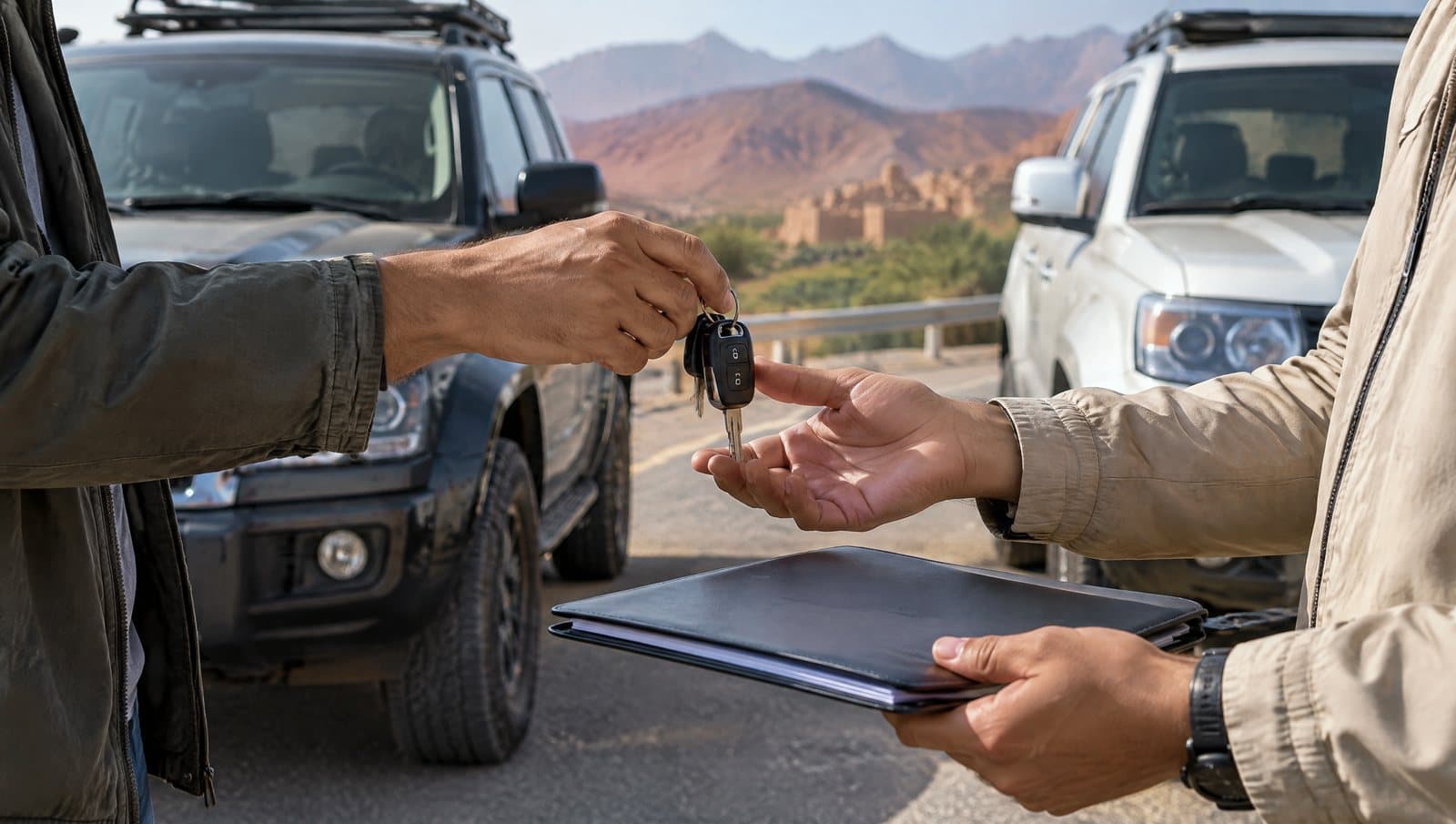
This is a common situation in the trade. A multi-day stay in a 4x4 with driver, based in Casablanca, does not always rely on the same person from the first day to the last. The transport company may organise rest periods, replace a driver who is unavailable or swap the vehicle. The DMC does not always choose these constraints, but it does choose how the handover is prepared.
This article focuses on the handover itself. To frame the service beforehand, read our guide on [calculating the duration and scope of a 4x4 vehicle hire](/en/blog/4x4-vehicle-hire-calculate-duration-scope-quote). For the whole coordination chain, see [how the platform works](/en/how-it-works).
Why customers notice a poorly prepared change
The customer does not judge your internal organisation. They notice the symptoms:
- they have to repeat what they have already said: preferred language, timings, wishes;
- the new driver does not know the planned stop or the agreed meeting point;
- a stranger is waiting for them without any warning;
- a promise made the day before (photo stop, break, adjusted pace) disappears;
- a forgotten item or an incident goes unanswered because the previous driver has already left.
In every case, the information existed, but it was in the first driver's head or in a private conversation. The handover is about getting it out of there.
The steps of a clean handover
- **Decide on the change as early as possible.** As soon as the transport company flags a replacement, ask who, when and with which vehicle. Do not rely on a verbal confirmation.
- **Choose the moment of the handover.** Prefer a natural break in the programme: return to the hotel, end of the day, start of the morning. Avoid the middle of a leg, on the road, in front of the customer.
- **Set the handover location.** If the handover takes place at a specific spot, write it down. If it takes place at the hotel or riad, do not assume anything about vehicle access: only the property confirms the drop-off and pick-up location.
- **Have the handover sheet written** by the outgoing driver or by the transport company, then review it on the DMC side.
- **Get the incoming driver to confirm they have read it**, in writing, before the handover. A simple “received” is enough, but it must exist.
- **Inform the customer** with the new driver's first name, the vehicle, the licence plate and the pick-up time.
- **Check the first contact.** Ask the incoming driver to confirm they are at the agreed point, then ask the customer to confirm the pick-up if the programme warrants it.
- **Close the handover.** Note what happened, so the file stays readable for the rest of the stay and in case of a dispute.
What the handover sheet contains
A good sheet fits on one screen. It does not tell the story of the stay; it gives what is needed to carry on without asking the customer any questions.
| Section | What to write | Why |
|---|---|---|
| Remaining programme | Upcoming stops, order, waypoints, planned duration and limits agreed in the quote | Avoid scope drift or a forgotten stop |
| Meeting point | Place, time, contact person, confirmation from the hotel or riad | The incoming driver does not discover the place on arrival |
| Travellers | Number, communication language, special needs relevant to driving | The customer does not have to introduce themselves again |
| Luggage and equipment | What is on board, what must be collected or dropped off | No luggage or item lost between two drivers |
| Commitments made | Promised stops, breaks, pace adjustments, DMC requests | Keep the word given without renegotiating it |
| Ongoing incidents | Delay, complaint, unresolved request, forgotten item | The file stays followed after the first driver leaves |
| Vehicle | Vehicle and plate, condition noted, particulars to report to the transport company | Avoid disputes over the vehicle's condition |
| Contacts | Who contacts whom: DMC, transport company, property | One person answers each problem |
Limit personal data to what serves the assignment. The incoming driver does not need the customer's entire file: only the elements useful for driving and welcoming.
Checklist before the handover
- The transport company has confirmed the incoming driver's name and the vehicle.
- The handover time and place are written down, not just spoken.
- The handover sheet is drafted and reviewed on the DMC side.
- The incoming driver has confirmed in writing that they have read the sheet.
- Driver and vehicle documents are up to date: ask the transport company to confirm them, as it is the one that holds them.
- The meeting point has been confirmed with the hotel or riad concerned.
- The customer has received the driver's first name, the vehicle, the plate and the time.
- The commitments made to the customer appear in the sheet.
- A DMC contact is reachable during the handover.
Template messages to adapt
To the transport company, as soon as the change is announced
“Hello, we note the driver change for the 4x4 stay on [date]. Please confirm in writing: the incoming driver's first name, the vehicle and its plate, and the time and place of the handover. We are sending you the handover sheet; please confirm that the incoming driver has read it.”
To the incoming driver
“Hello, you are taking over [customer's first name]'s stay from [time] at [confirmed location]. Here are the remaining programme, the commitments made and the points to watch. Please reply “received” and let us know of any question before the handover, not after.”
To the customer
“Hello, from [time], [driver's first name] will be accompanying you in a [vehicle], plate [plate]. He knows your programme and your preferences. Your meeting point remains [location]. If you have any questions, just reply to this message.”
If the customer is to meet the outgoing and incoming drivers at the same time, say so in the message. A few seconds of introduction is better than an unexpected arrival.
Common mistakes
- **Handover mid-leg.** The customer is left alone with a driver who does not have the rest of the programme in mind. Move the handover to a break.
- **Sheet sent without read confirmation.** You do not know whether the incoming driver has read anything.
- **Instructions given by phone only.** Nothing can be retrieved in case of a disagreement.
- **Assumed drop-off location.** Never assume vehicle access to a riad or the medina: have the riad confirm the location. Our article on [agreeing the drop-off point with the riad](/en/blog/riad-medina-agree-drop-off-point-with-the-riad) details the method.
- **Customer informed too late.** A message sent at the last minute looks like improvisation.
- **Scope not passed on.** The new driver accepts a stop outside the quote, or refuses a planned one.
- **No record of the handover.** Afterwards, nobody knows who drove what and when.
Who does what: DMC, transport company, driver
| Party | Responsibility in the handover |
|---|---|
| DMC | Decides the handover moment with the transport company, reviews the sheet, informs the customer, keeps the thread of the file |
| Transport company | Assigns the driver and vehicle, confirms their identity, keeps documents up to date, checks the rest rules that apply to it |
| Outgoing driver | Writes or completes the sheet, reports ongoing incidents and items, stays reachable until the handover is confirmed |
| Incoming driver | Reads the sheet, confirms in writing, arrives at the agreed point, applies the commitments made |
| Hotel or riad | Confirms the drop-off and pick-up location, informs its team that a new driver is arriving |
Drivers and transport companies will find further guidance on the [transport companies](/en/transport-companies) and [drivers](/en/drivers) pages. For a stay that chains several cities, also see [chaining the transfers of a multi-city circuit](/en/blog/multi-city-circuit-morocco-chaining-transfers-agency).
Keeping a record of the handover
A successful handover leaves a record: who was assigned, when, which stages were completed. This record is used to answer a complaint, justify an invoice or understand an incident. Decide before the stay where it will be kept and who fills it in. The principle is simple: a single file, which everyone accesses according to their role.
With WAYLISS
- The transport company assigns the driver and vehicle; the property sees the driver’s first name, the vehicle and the plate.
- The link shows the meeting point, then the driver’s first name, the vehicle and its plate once assigned.
- Each ride keeps a viewable history: request, assignment and steps.
- The information each party needs comes from the same file, according to its role and rights.
Learn more: How WAYLISS works
Frequently asked questions
Should the customer always be told about a driver change?
Yes. Even if the change is minor, the customer must know the driver's first name, the vehicle, the plate and the pick-up time. A stranger turning up unannounced creates mistrust.
Should the outgoing driver stay until the handover?
Agree on this with the transport company before the stay. At a minimum, they must remain reachable until the incoming driver has confirmed the pick-up. Rest and availability rules are the transport company's responsibility: ask it to specify them.
What if the change is forced at short notice, for example after a breakdown?
Apply the same logic in short form: ask the transport company for the replacement's name, the vehicle and the plate, send the remaining programme in writing, get confirmation that it has been read and inform the customer without delay.
What customer information should be passed to the incoming driver?
Only what serves the assignment: programme, communication language, number of travellers, luggage, needs relevant to driving and commitments made. Avoid passing on data that is not necessary.
Can a driver change be avoided altogether?
Not always. If continuity matters to the customer, say so in the brief to the transport company and ask it to confirm what it can guarantee. Framing the service is covered in our article on [sedan vehicle hire in Casablanca](/en/blog/sedan-vehicle-hire-casablanca-brief-mistakes-agency), whose logic also applies to a 4x4.