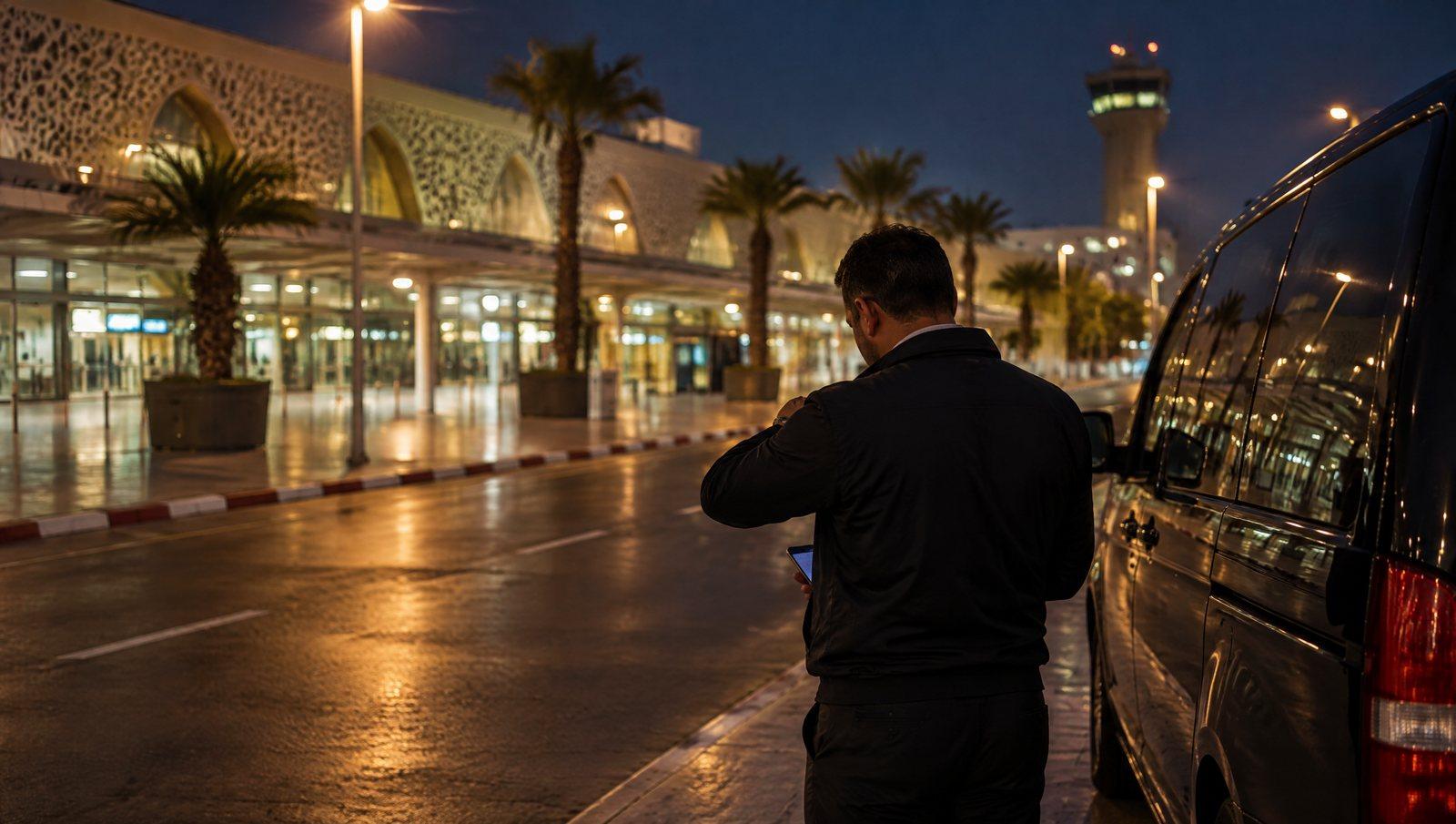
Why a no-show is settled before the day itself
A customer who is missing at the meeting point puts three people under pressure: the driver who is waiting, the front desk that receives the driver's call, and the transport company that sees its vehicle tied up. Without a written rule, everyone improvises. The driver leaves too early or stays too long. The hotel finds out after the fact. Invoicing turns into a dispute.
The subject of waiting in general, flight delays and the last trip is covered in our guide to organizing an airport–riad transfer. Here, we focus on a single case: the customer does not show up, and nobody knows why.
What to agree with the transport company, point by point
These points are set in writing, once, for all your transfers. Durations and amounts are part of your commercial agreement: we deliberately give none, because they depend on each transport company and each service.
| Point to agree | Question to ask | Who decides |
|---|---|---|
| Definition of a no-show | From what point is the customer considered absent: after how long a wait, and after which contact attempts? | Hotel and transport company, together |
| Start of the wait | Does the wait run from the time stated in the request, or from the moment the driver is at the meeting point? | Transport company, validated by the hotel |
| Included waiting time | How much time is included in the price, and what happens beyond that? | Written commercial agreement |
| First contact with the customer | Who tries to reach the customer first, and through which channel: call, WhatsApp, email? | Hotel, unless agreed otherwise |
| Escalation | What does the driver do if there is no way to reach the customer? Who should be alerted at the front desk, and at which number? | Hotel (on-call contact) |
| Authorization to leave | Can the driver leave alone at the end of the wait, or wait for the hotel's confirmation? | Hotel |
| Invoicing | Is the no-show invoiced, and on what basis? Is a new transfer a new service? | Written commercial agreement |
| Record | What is recorded: times, contact attempts, final decision? | Hotel and transport company |
For invoicing and any cancellation or no-show conditions, check what your contractual terms provide and, if needed, have them reviewed. Never present a rule to a customer as "customary" without having verified it.
What the hotel prepares in the request
A no-show can be partly prevented at booking. The more complete the request, the less the driver searches for a customer who may not be absent, but simply in the wrong place.
- Flight, time, number of travelers and luggage stated without ambiguity.
- Meeting point described in simple words, identical in the request and in the message to the customer.
- A traveler contact number reachable on arrival, or failing that, a way to reach them via the hotel.
- The name or wording that will appear on the sign, communicated to the customer in advance.
- For a riad, the drop-off location confirmed by the riad itself, never assumed: see how to agree on the drop-off point with the riad.
A structured request (flight, time, travelers, luggage, meeting point) prevents most false no-shows. For the driver's actions on site, see the essentials for welcoming a customer at the airport.
On the day: the steps to follow in order
- **Check the request.** The driver rereads the meeting point, the name on the sign and the number of travelers. They confirm they are in the right place.
- **Tell the hotel the customer is not at the meeting point.** A short message, with the exact time and place. Do not wait until the end of the waiting time to alert them.
- **The hotel tries to reach the customer.** A call, then a message on the usual channel. The hotel also checks whether it has received a last-minute change.
- **Widen the search around the meeting point.** The driver stays visible with the sign, checks the agreed spot, then the immediate surroundings, without leaving the vehicle for too long.
- **Inform the transport company.** The operations manager knows the vehicle is tied up and can reorganize the rest of the day.
- **Reach the end of the agreed wait.** At that point, the driver does not decide alone: they ask for the instruction set out in the protocol (departure authorized or wait extended).
- **Decide and say so in writing.** The hotel confirms to the transport company: departure, extended wait accepted, or transfer to be rescheduled.
- **Inform the customer.** As soon as they can be reached, the hotel explains what happened and what is being offered.
- **Record.** The driver's arrival times, contact attempts, decision, departure time.
When the hotel follows the assignment, it sees the driver's first name, the vehicle and the license plate, which makes communication with the customer and with the transport company easier. The link sent to the traveler shows the meeting point, then this same information once the assignment is made. Each trip keeps a viewable history (request, assignment, steps), useful for reconstructing what happened in case of a dispute.
The special case of minibuses and groups
With a minibus, a no-show is rarely total. Often, part of the group is there and the other part is missing. Agree on this in advance, because the decision is not the same as with a sedan.
- **Partial group:** do you wait for all travelers, or leave with those who are present? The hotel decides, with the transport company's agreement.
- **Vehicle tied up:** a minibus that is waiting cannot do another trip. The transport company must be able to say whether it has other commitments afterwards.
- **Travelers already on board:** if part of the group has boarded, plan how they are informed and what wait they accept.
- **Reference contact:** for a group, designate a single contact person on the traveler side, communicated before arrival.
- **Return of the rest of the group:** agree whether a second vehicle can be sent and under what conditions.
To name the vehicle correctly in the request, see sedan, van, minibus: what each category means. If the customer had booked a vehicle for a block of time, the logic is not that of a simple transfer: transfer, vehicle hire, excursion: naming the service correctly.
Reusable message templates
Driver or transport company to the hotel
Hotel to the customer
Hotel to the transport company, to close
Common mistakes
- **Letting the driver decide alone** on departure, without a clear instruction from the hotel.
- **Alerting the hotel too late**, when the agreed wait has already elapsed.
- **Failing to distinguish** between the late customer, the lost customer and the truly absent customer.
- **Applying an unwritten invoicing rule** and discovering it at the time of a dispute.
- **Forgetting to check** messages received at the front desk before concluding it is a no-show.
- **Recording nothing**: without times or contact attempts, the discussion rests on memories.
Checklist: to validate with your transport company
- Written definition of a no-show.
- Start of the wait and included duration specified.
- On-call contact at the hotel, with a reachable number.
- Who calls the customer, and through which channel.
- Departure instruction: autonomous or upon hotel confirmation.
- Invoicing rule for the no-show and the new transfer, verified contractually.
- Partial group case handled for minibuses.
- Items to record: times, attempts, decision.
- Template message ready for the driver, the hotel and the customer.
To frame this protocol with your partners, you can start from the page dedicated to hotels, the one for transport companies and the one for drivers. For an overview of the coordination between these players, see how transfer coordination works.
With WAYLISS
- The property enters a structured request: flight, time, travelers, luggage and meeting point.
- The transport company assigns the driver and vehicle; the property sees the driver’s first name, the vehicle and the plate.
- The link shows the meeting point, then the driver’s first name, the vehicle and its plate once assigned.
- Each ride keeps a viewable history: request, assignment and steps.
Learn more: How WAYLISS works
Frequently asked questions
How long should a driver wait for an absent customer?
There is no duration to copy as it stands: it is set in the agreement between the hotel and the transport company. Agree on an included duration, on when it starts and on what happens beyond it.
Who should try to reach the customer first?
Generally the hotel, which knows the customer and has their contact details. Agree on this in advance with the transport company, as well as on the channel used.
Is a no-show always invoiced?
It depends on what was agreed between the hotel and the transport company, and on your contractual terms. Check it in writing beforehand, never after the incident.
What should be done if the customer calls after the driver has left?
The hotel contacts the transport company to find out whether a new transfer is possible and under what conditions. Inform the customer clearly, without promising anything before the transport company replies.
Is a different protocol needed for a minibus?
Yes, at least on one point: handling a partial group. Decide beforehand whether to wait for all travelers or leave with those who are present.