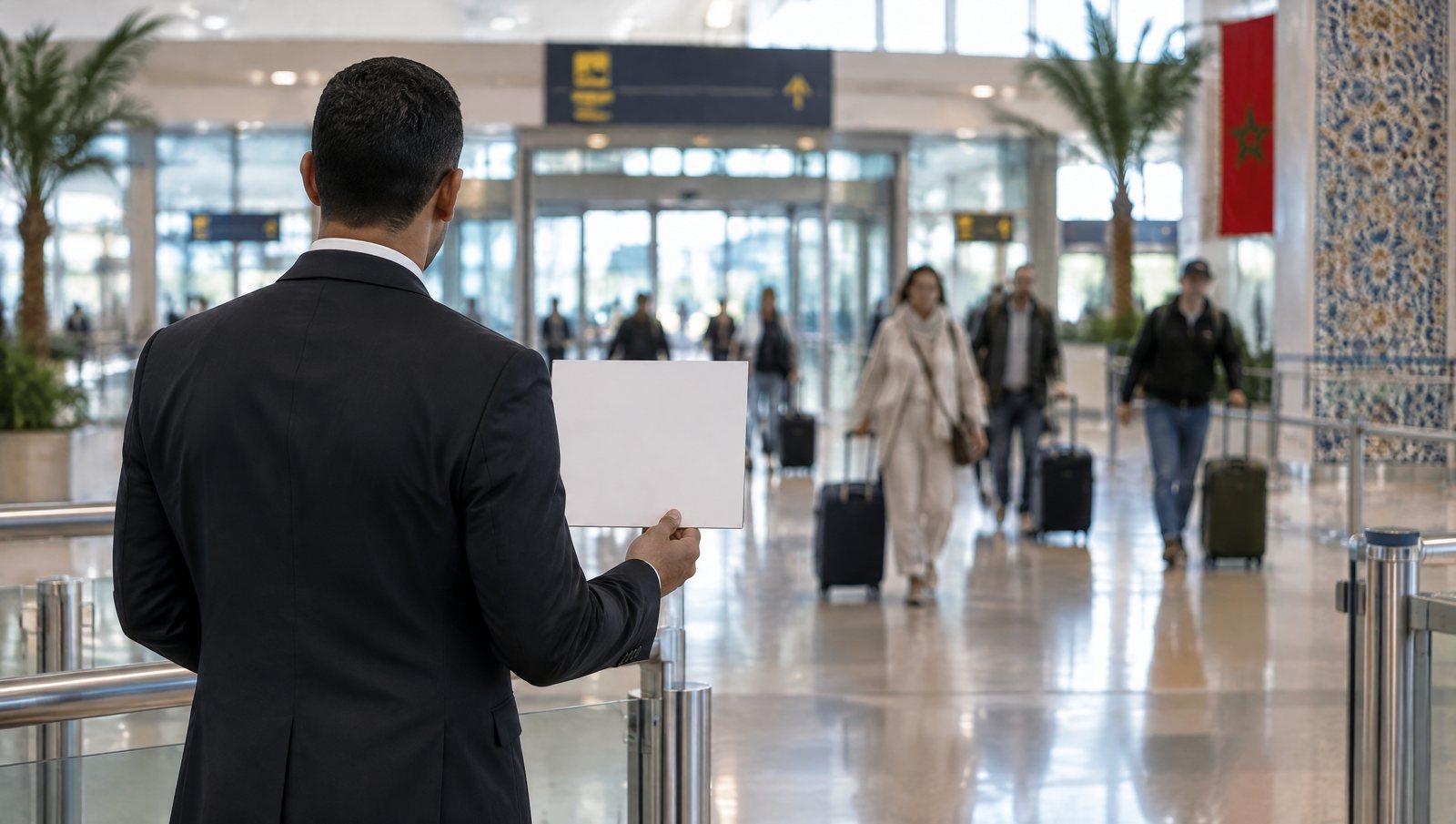
The first minutes shape how the whole trip is perceived. The traveler has just stepped off a flight, is tired, and is sometimes anxious. They are looking for a face and a confirmation. Your job: give them both, quickly and without ambiguity.
Before entering the hall: preparation
A botched welcome almost always starts before the arrival. Review the trip file methodically.
- The exact name to write on the sign, as it appears in the request.
- The time and flight number given in the request.
- The agreed meeting point, not just “arrivals”.
- The number of travelers and bags, to check that the vehicle is suitable.
- The destination, and the name of the contact person to reach if there is a problem.
If the number of bags seems incompatible with the planned vehicle, report it before departure, not in front of the customer. Our guide on choosing a vehicle by travelers and luggage details the criteria.
The sign: what makes it useful
The sign is not decoration. It is the tool that lets the customer identify you from a distance, in the crowd.
- One name only, in large letters, legible from a distance. No logo taking the place of the name.
- Capital letters, thick marker, light background. A clean, uncrumpled board.
- Hold it at chest height, facing arriving passengers, without lowering it when you look at your phone.
- Write the name as it appears in the request. If the customer booked for a group, check which name is the reference.
- Do not hide your face behind it: the customer should see a person.
The steps of the welcome, in order
- Position yourself at the agreed meeting point before the customer arrives, and stay there.
- Spot travelers who hesitate or are searching. A glance and a smile are enough to engage.
- Introduce yourself by first name and confirm the customer's name: “Hello, I'm [first name], your driver. Are you [name]?”
- Confirm the destination out loud: “We're going to [hotel or riad], is that right?”
- Offer to take the luggage, without pulling it from their hands. Let the customer keep their valuables.
- Guide them to the vehicle, walking at their pace, slightly ahead, without leaving them behind.
- At the vehicle, let the customer get in, then load. Check that nothing is left on the ground before setting off.
- Say what will happen: the trip, any stop, and how to reach you if needed.
Real cases: what actually happens
| Situation | What to do | Mistake to avoid |
|---|---|---|
| The customer can't see you | Stay at the agreed point, raise the sign slightly, contact them through the agreed channel | Walking around the whole hall and leaving the meeting point empty |
| The flight has landed but the customer is late | Wait at the agreed point and inform your contact if the wait goes on | Leaving without warning anyone |
| More luggage than planned | Say so calmly, check what is possible, inform your contact | Forcing the loading or refusing without explanation |
| A customer approaches you without a name on the sign | Ask for their name and destination before accepting | Taking them on their word alone |
| The customer is in a hurry or tired | Be brief, efficient, quiet if needed | Pushing a sightseeing conversation |
| The drop-off location is uncertain | Ask the hotel or riad to confirm the drop-off location | Promising a drop-off point before the hotel or riad has confirmed it |
What to say: reusable templates
A few ready-made phrases, to adapt to the customer's language.
- Greeting: “Hello [name], I'm [first name], your driver for [property]. Welcome.”
- Luggage: “May I take your bags? The vehicle is very close.”
- Confirmation: “I'll drop you at [property]. The exact drop-off location has been confirmed by the property.”
- Message before arrival: “Hello, I'm [first name], your driver. I'll be waiting for you at [meeting point] with a sign with your name.”
- Delay on your side: “I apologize, I'm arriving at [meeting point]. I'll let you know as soon as I'm in place.”
What the customer should already know
The welcome is easier when the customer knows in advance who is coming to pick them up and where. When coordination is done well, they receive the meeting point beforehand, then your first name, your vehicle and your plate. They recognize you faster and are not following a stranger. It also reassures the property that sent them.
To understand how this information flows between property, transport company and driver, see the page dedicated to drivers, then how the service works. On the property side, the article on how a hotel can organize guest transfers shows what your contact should pass on to you.
Checklist before every arrival
- Name, flight and meeting point reread in the file.
- Clean sign, legible name.
- Clean vehicle, free trunk, suited to the announced luggage.
- Phone charged, contact channel ready.
- Destination and drop-off location confirmed by the property.
- Professional ID and vehicle documents up to date, as your transport company requires.
Common mistakes
- Standing somewhere other than the agreed spot.
- Writing a nickname or an agency name instead of the customer's name.
- Staying glued to the phone instead of watching arriving passengers.
- Announcing a price or a surcharge to the customer without your contact's prior agreement.
- Loading the luggage without making sure the customer is ready.
- Forgetting to confirm the destination out loud.
With WAYLISS
- The link shows the meeting point, then the driver’s first name, the vehicle and its plate once assigned.
- The transport company assigns the driver and vehicle; the property sees the driver’s first name, the vehicle and the plate.
Learn more: WAYLISS for drivers
Frequently asked questions
Frequently asked questions
What should I do if the customer doesn't show up?
Stay at the agreed meeting point and use the agreed contact channel. Then inform your transport company or the property before leaving, according to the instructions you received.
What should the sign contain?
The customer's name, as it appears in the request, in large, legible letters. Avoid any addition that reduces legibility.
Should I always carry the luggage?
Always offer. If the customer prefers to keep a bag, respect their choice. For bulky luggage, check that it fits in the vehicle before loading.
Can I promise to drop the customer in front of their riad?
No. Only the riad confirms the drop-off location. Ask it for this information and pass it on to the customer without changing it.
How do I reassure an anxious customer?
Give your first name, confirm the property's name and the destination, then explain what comes next simply. Clear information reassures more than a long speech.